Stage 1, Stage 2, Stage 3 — what each one actually does, when to switch, what size to order, and honest answers to the questions we get asked every single day.
AThe Aryella™ Fit TeamUpdated May 20259 min read
First, the most important rule
Your surgeon's protocol always wins. Every practice has its own timeline for compression, and only your surgeon knows your procedure, your drains, your incisions and your healing. This guide explains what each stage is designed to do so you can shop with confidence — it is educational, not medical advice.
The short answer
Choose your stage by where you are in healing — not by how much compression you want.
1
Stage 1 — day one to roughly week 2–4. Soft, low-to-medium compression. Gentle, breathable, easy to get in and out of while you're sore and swollen.
2
Stage 2 — roughly week 3–4 through week 8–12. Firmer compression that refines your contours as swelling drops and your new shape settles.
3
Stage 3 — month 2–3 and beyond. High-compression maintenance and everyday shaping, worn as long as you like your results held in place.
What "stage" actually means
A stage isn't a brand or a style — it's a level of compression matched to a phase of healing. Right after a procedure your body is swollen, tender and full of fluid. Compression at that moment has one job: support the tissue, help fluid drain and keep everything calm. That takes a soft, forgiving garment.
Weeks later, the swelling is going down and your new silhouette is appearing. Now compression has a different job: hold the contour, keep the skin adhering smoothly to the tissue beneath, and shape. That takes a firmer garment — and the one you started in will feel loose and start to shift.
That's the whole logic. Most patients need two garments minimum across recovery, and many add a third for maintenance. Wearing a Stage 3 garment in week one is not "faster results" — it's pressure your healing tissue isn't ready for.
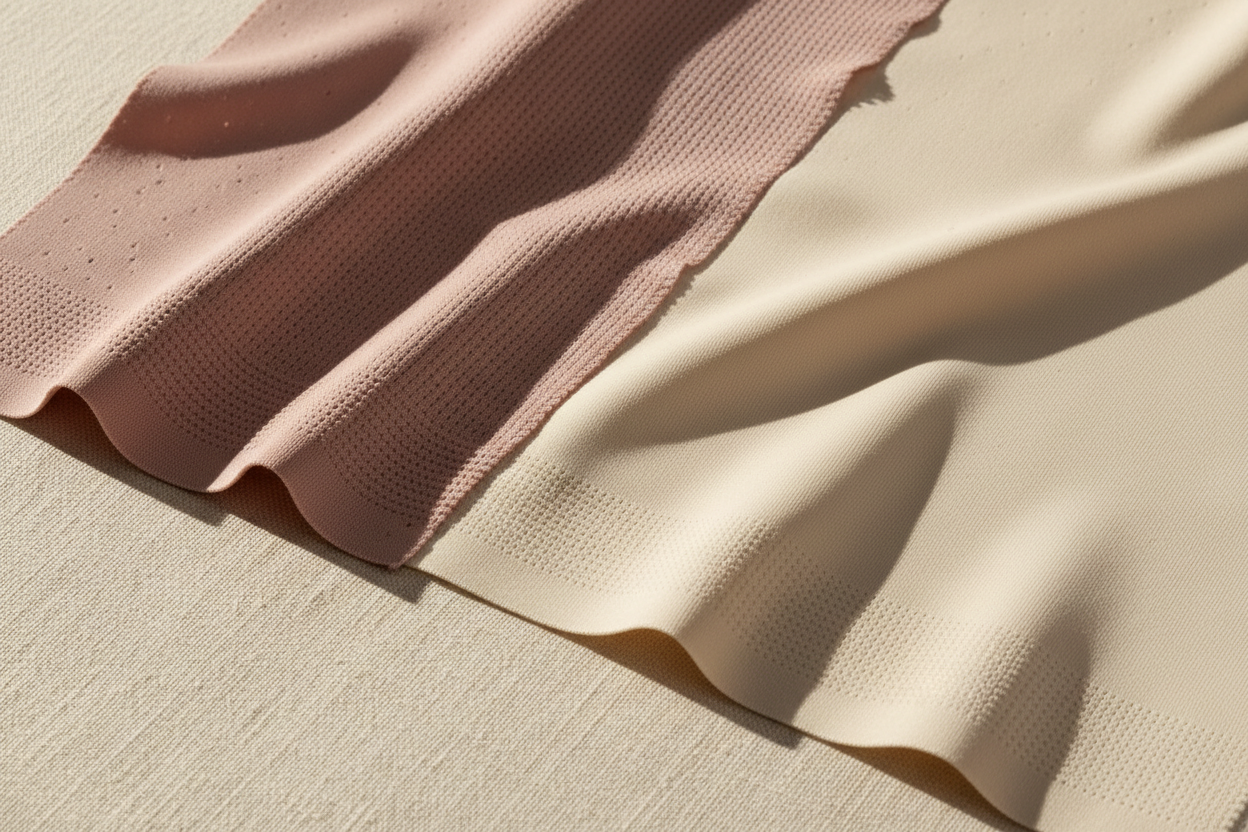
Left: the softer, breathable knit used in recovery garments. Right: the firm sculpting powernet of a later-stage faja. Same idea, very different feel.
This is the one you go home in, or switch into at your first post-op visit. It should feel like a firm, steady hug — supportive, never sharp. Soft breathable fabric, wide panels, no aggressive boning digging into tender areas, and closures you can manage with limited range of motion. If it's the garment you'll live in for 23 hours a day, comfort is a clinical feature, not a luxury.
Once your surgeon clears you, you step up. Your Stage 1 garment is now loose because the fluid it was managing is gone — and a loose garment shapes nothing. Stage 2 is firmer and more contoured: a defined waist, a lifted seat, smoother compression across the abdomen. Many patients also drop one size here, because the measurement that mattered in week one no longer describes your body.
What changes
Firmer fabric that holds your new contour
A more sculpted cut — waist definition, glute lift
Slimmer profile you can wear under real clothes
Easy on/off, because you're back to daily life
Common mistake
Jumping to Stage 2 early because Stage 1 "feels loose." Looseness in week one usually means swelling has shifted, not that you're ready for more pressure. Ask at your follow-up before you switch — going firm too soon can irritate incisions and even mark the skin.
Stage 3 is optional, and it's where recovery turns into routine. High-compression fajas and waist trainers with structured boning keep your waist defined under clothing, support your back, and give you that pulled-together line on event days. Wear it because you like how you look in it — most patients use it part-time, not around the clock.
Best for
Holding results once you're fully cleared
Everyday waist definition under clothing
Posture and lower-back support
Events, travel and photos
Keep in mind
High compression is not a substitute for healing time. If you're still swollen, tender or in your surgeon's protocol window, stay where you are — Stage 3 will still be there in a month, and your results will be better for the patience.
Timelines are typical ranges, not rules. Your surgeon may move you faster or slower.
Comparison of Stage 1, Stage 2 and Stage 3 post-surgical fajas
Stage 1
Stage 2
Stage 3
When
Day 1 → week 2–4
Week 3–4 → week 8–12
Month 2–3 onward
Compression
Low to medium
Medium to high
High
Main job
Support tissue, manage swelling and fluid
Refine contour, smooth skin adherence
Maintain results, everyday shaping
Feel
Snug and cushioned, never pinching
Firm and defined
Strong, structured cinch
Wear time
Around the clock, off to shower
12–23 hrs, tapering
As you like it
Structure
Soft panels, minimal or no boning
Contoured panels, light structure
Steel boning, high-back support
Size
Your measured size — never smaller
Often one size down from Stage 1
Your true post-swelling size
Scroll the table sideways on mobile to see every stage.
Know your moment
Five signs you're ready for the next stage
If three or more of these are true — and your surgeon agrees — it's time to size up in compression and, usually, down in size.
01
Your surgeon cleared you. Non-negotiable, and usually at the 2–4 week visit.
02
You're on the tightest closure and the garment still shifts, rolls or gaps.
03
Swelling has clearly dropped — your waist measurement has changed since surgery.
04
Incisions are closed and calm — no open areas, drainage or raw spots under seams.
05
You're moving normally. You can dress yourself, so firmer closures are manageable.
Sizing without guessing
The single most common regret we hear isn't about the stage — it's about the size. Two rules cover almost every case: never size down for Stage 1, and measure again before Stage 2.
Measure three points
Under bust, natural waist and the fullest part of your hips — tape snug, level, not pulled tight.
Between sizes? Go up
Especially for Stage 1. You can tighten a garment through its closures; you can't loosen one that's too small.
Start on the loosest row
Adjustable fit levels exist so one garment carries you through weeks of changing swelling.
The fit test, in ten seconds
You can slide two fingers flat under the edge. You can take a full, deep breath. You can sit down without the panel folding into a hard ridge. Your skin isn't white, numb or dented after an hour. If any of those fail, the size or the stage is wrong — not your body.
Shop by stage
Aryella™ garments for each phase
Colombian-made compression, built for the stage you're actually in.
Most protocols run 6 to 12 weeks total, split across two garments: Stage 1 almost around the clock for the first 2–4 weeks, then Stage 2 for another 4–8 weeks with wear time gradually tapering. Some surgeons extend compression to 3–6 months for procedures involving extensive contouring. Your practice's timeline is the one to follow.
Do I really need two fajas, or can one carry me through?
Plan on two. A Stage 1 garment can't deliver the firmness your contour needs at week six, and a Stage 2 garment is too aggressive for week one. Many patients buy two of their Stage 1 size so one can be washed and dried while the other is worn — that's the single most practical thing you can do for the first month.
What size should I order if I'm still swollen?
Order your measured size for Stage 1, and if you fall between two sizes, take the larger one. Swelling peaks around days 3–5, so a garment that barely closes on day one will be unwearable exactly when you need it most. Adjustable hook rows let you tighten as swelling falls. For Stage 2, measure again — many patients land one size down.
Can I sleep in my faja?
In Stage 1, yes — that's the point, and most surgeons ask for 22–24 hours a day with breaks only for showering and washing the garment. High-compression Stage 3 waist trainers are a different story: they're designed for waking hours, not overnight wear.
My faja feels too tight. Is that normal or a problem?
Snug and supportive is normal. Numbness, tingling, shortness of breath, skin that stays dented or discolored, or pain that grows the longer you wear it are not — loosen a row and call your surgeon's office. Compression should never restrict circulation or breathing, and more pressure does not mean a better result.
Does a faja prevent fibrosis or lumps?
Even, well-fitted compression helps the skin adhere smoothly to the tissue underneath and supports fluid drainage, which is why surgeons pair it with lymphatic massage. What it cannot do is fix a garment problem: a rolled edge, a bunched seam or a wrong-size band can press a crease into healing tissue. Smooth the garment every time you put it on, and use foams or boards if your surgeon recommends them.
Hooks, zipper, or both — which closure should I pick?
For Stage 1, prioritize whatever you can manage alone while sore: multiple hook rows give you adjustability as swelling changes, and a front zipper makes getting in and out dramatically easier. Single-row-plus-zipper designs are the easiest of all. By Stage 2 and 3 you have full mobility, so you can choose based on shaping rather than access.
Can I use a post-surgical faja after a C-section or pregnancy?
Yes — postpartum recovery follows the same logic, and Stage 1 garments are the standard starting point because they're soft, breathable and don't press on an incision. Get your OB's clearance first, especially after a cesarean, and keep the top edge well away from the incision line.
How do I wash it without ruining the compression?
Hand wash in cold water with a mild detergent, skip bleach and fabric softener, don't wring or twist it, and always air dry in the shade — never a dryer. Heat and agitation destroy elastic fibers, and a stretched-out faja stops doing its job. This is the other reason a second garment is worth it.
Can I skip Stage 1 and go straight to a high-compression faja?
Please don't. Early tissue is fragile and full of fluid; firm boning and aggressive panels on day three can irritate incisions, mark the skin and create the exact irregularities you're trying to avoid. Stage 1 isn't a lesser garment — it's the right tool for that specific window.
What can I wear over my faja?
In the first weeks: loose dresses, soft wide-leg pants, oversized shirts — anything that doesn't add a second layer of pressure. By Stage 2 the garments are slim enough to disappear under normal clothing, and Stage 3 pieces are designed to be invisible under a fitted dress.
How long until I see my final shape?
Expect a first real preview around weeks 6–8, a much clearer picture at 3 months, and the final result somewhere between 6 and 12 months as residual swelling resolves. Consistent, correctly-staged compression through that window is one of the few parts of the process fully in your hands.
Not sure which stage you're in?
Tell us your procedure date and your surgeon's instructions, and our fit team will point you to the right garment and size. Or get recovery guides and new arrivals in your inbox.